
-
History
-
Alexandra Docks
-
Town Dock
-
Newport Dock Disaster
Town Dock
The Town Dock, which opened in 1842 and continued in use until it was filled in 1930, was the first floating dock facility in Newport. The construction of the dock played an important part in the town’s growth in the mid Nineteenth Century. A rapid expansion of trade caused by the development of the canal system in South East Wales had led to the need to improve the port’s berthing facilities. Particularly for large American export vessels which risked damage when beached at the wharves for unloading. If the town was to continue to prosper and compete with the growing port of Cardiff a dock needed to be constructed.
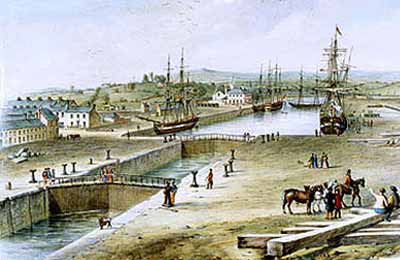
The Town Dock, a sketch by J F Mullock, circa 1842
At a public meeting held at the King’s Head Inn in March 1835 the plans of the floating dock were agreed. A committee, made up of some of the leading gentlemen of Newport, was appointed to examine the provisions of the Bill that was to be put before Parliament.
The Town Dock, a sketch by J F Mullock, circa 1842The Newport Dock Act was given Royal Assent in July 1835 allowing the Newport Dock Company to begin construction work. The estimated cost of the dock was to be £35,000 which was raised by selling 350 shares of £100. The first sod was cut by John Owen, Mayor of Newport, on 1st December 1835 to the sound of the bells of St Woolos, the firing of guns and the celebrations of the Navvies, who had been supplied with several barrels of Castle Brewery beer for the occasion.
However, the construction of the dock did not run smoothly. A number of contractors had to be used at various stages and as early as 1836 there were labour disputes. Consequently, even by the end of 1837 little work had been completed. In 1838 another £15,000 needed to be raised but progress continued to be slow. More funds needed to be raised in October 1840 and by then the estimated cost of the project had risen to £120,000. Work was halted in December 1840 following the failure of another contractor and was to halt again in 1841. After more funds were raised work resumed for a fifth time in April, but by then the total estimate had grown to £131,000. Financial problems and industrial unrest continued to plague the construction to the very end. In September 1842 a further £10,000 had to be borrowed and workers walked out to demand higher wages, an event which led to a body of well armed police being sent to quell the disturbance.

Map of the Town Dock and Surrounding area, circa 1905
The official opening of the Dock on 10th October 1842 was marked by a programme of festivities that attracted tens of thousands of visitors to the town. In the morning a mile long procession proceeded along High Street through Commercial Street and Commercial Road towards the Dock. The procession contained elements of the major clubs and societies of Newport in this period such as the Freemasons, the Oddfellows, The Hibernian Society and the Teetotallers. Near the head of the procession the Mayor and Aldermen travelled in open carriages whilst at the rear marched a large number of the inhabitants of the town, amongst whom many of the gentlemen wore white rosettes.
At 10-o-clock the lock gates were opened, as the Monmouthshire Merlin reported, to the sound of “the shouts and cheers of the spectators, the thunder of cannons, firing of musketry and pealing of bells.” The first vessel to enter the dock was the Henry.
Following the official opening the programme of events continued throughout the day. Highlights included a dinner for 300 gentlemen of the area at the National School, boat races on the dock reservoir and a firework display at Rodney Wharf. In the evening a ball was held for the gentry at the King’s Head Hotel. The Clubs and Societies also held their own balls and dinners at Inns throughout Newport, a Tradesman’s Ball at the Steam Packet Inn was reported to have “kept up with much spirit until morning”.
The Monmouthshire Merlin newspaper does not report on how the town’s population felt the next day.
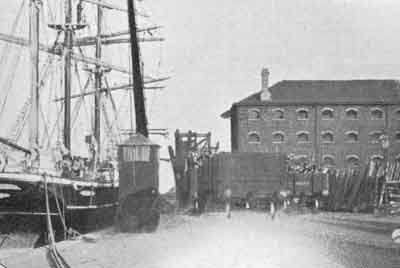
Timber Ship and Warehouse at the Town Dock, circa 1905
However, shortly after its opening it was apparent the existing dock was not sufficient to deal with the increasing trade. In July 1854 a second act was passed giving the Newport Dock Company permission to extend the dock to the North. Work commenced in June 1856 and was completed in less than two years. The official opening on 2nd March 1858 was declared a public holiday and was greeted with similar celebrations to when the dock was opened in 1842.
The dock expansion was not initially the success that the Newport Dock company hoped for and the company faced severe criticism, especially after they increased their charges. It was now obvious that the Town Dock alone was no longer sufficient to meet the volume of trade passing through Newport. In 1865 an act was passed to allow the construction of a second dock and in 1868 work began on the Alexandra Dock, which opened in 1875.
Unsurprisingly, the opening of the rival dock had a detrimental effect on the trade of the Town Dock, although it was the accident involving the Constancia and the Primus which ultimately led to the demise of the Newport Dock Company.
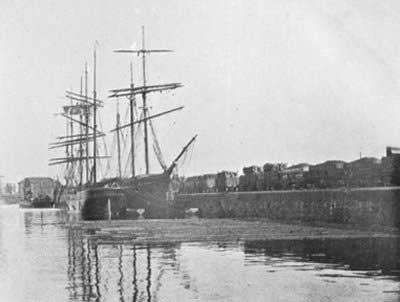
Unloading timber for pit props at the Town Dock, circa 1905
On 10th January 1882 the two vessels attempted to pass through the lock at the same time but the Primus became stuck on the sill of the outer gates and the ships collided. The Monmouthshire Merlin describes how the situation became critical as the tide began to recede because “the bottom of the lock being concave in form, as the water ebbed the steamers heeled over one on the other, the Primus carrying away her masts, breaking in two amidships and, of course, subsiding to the bottom, whither she was followed by her companion in misfortune.” The lock was completely blocked and the vessels already in the dock trapped for nearly two weeks. The accident incurred substantial expense for the Newport Dock Company and further eroded customer confidence in the company.
A year later the Newport Dock Company was sold to the Alexandra Dock Company for £150,000. From this moment the Town Dock was used for dealing with the smaller vessels whilst larger cargoes were concentrated at the Alexandra Dock. By 1900 the Town Dock was used primarily for the general import trade, particularly in timber. However, its relatively small size and position further up the river estuary than the Alexandra Dock made the Town Dock particularly vulnerable. Unable to survive the downturn in trade in the 1920’s the Town Dock was finally closed in October 1930.
These web pages were written using material held in the Local Studies Collection at Newport Central Library, including:
Newspapers
- The Monmouthshire Merlin
- The South Wales Argus
Printed Works
- Leonard, T. Newport Town Dock 1835 - 1842. (qM160 627.3 LEO)
- Spanswick, B J. A Study of the Origins and Early Development of Newport Docks. (qM160 627.3 SPA)
- Alexandra (Newport and South Wales) Docks & Railway Company. (M160 627.3 ALE)
- Smith, T. G. A Customs History of the Port of Newport in Gwent Local History No. 46 (Spring 1979) (M000 900 GWE)
If you wish to learn more about the history of Town Dock, or any other aspect of Newport’s history, visit the Central Reference Library where staff will be happy to assist you.
They can also be contacted by telephone on 01633 656656 or email at reference.library@newport.gov.uk
The Alexandra Docks
Despite the opening of the Town Dock in 1842 and its extension in 1858, the continued expansion of the overseas coal trade, fuelled by improved railway links, led to a need to further expand the port facilities at Newport.
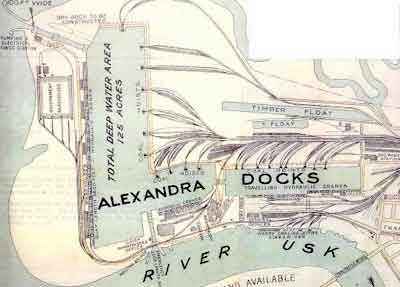
Plan of Alexandra Docks, April 1919
Leading industrialists of the Monmouthshire region, exasperated by delays caused by a lack of shipping accommodation, began a movement to construct new dock facilities. Initially two competing schemes were proposed: the first by the East Usk Railway & Docks Company to construct a new docks on the East Bank of the Usk River; the other by the Alexandra Dock Company to build the docks on the West bank of the river. The issue was decided in favour of the Alexandra Dock Company and on 6th July 1865 the Alexandra (Newport) Dock Act 1865 was passed, giving the company the authority to construct the new dock.
Work commenced in May 1868 and the new facility was officially opened on 16th April 1875. The dock was 2,500 feet long with a width of 500 feet and covered a total area of 28 and half acres. Entry to the dock was gained from the River Usk through an entrance lock that was 350 feet long and 60 feet wide. But even the opening of the Alexandra Dock could not relieve the pressure. Between 1877 and 1881 coal exports doubled from 610,000 tons to 1,200,000 tons, so to deal with this increased trade and ensure Newport’s place as one of the pre-eminent coal ports plans were drawn up to extend the Alexandra Docks.
The new South Dock (the existing dock would now be known as the North Dock) was designed as a separate dock to be connected to the North Dock at Junction Cut by a channel 60ft wide, which was spanned by a hydraulically controlled swingbridge. On 30th January 1883 the first sod of the Dock was cut by the coalowner Sir George Eliot and when work was completed in December 1892 the South Dock measured 1,500 feet in length, 650 feet in width and covered an area of 20 acres. A new South Lock measuring over 500 feet in length connected the Dock to the River Usk. But even this expansion of the port facilities was not enough to match the increasing demand, so in June 1905 work was commenced on the largest single expansion of the dock facilities.

Aerial View of Alexandra Docks, circa 1920
The South Dock extension opened in November 1907, contractors having taken only two years to excavate an area of 48 acres. This had been achieved by working both day and night using artificial light. During these excavations, a section of the River Ebbw was diverted and the old river bed was incorporated into the Dock area. A problem with the extension was that it did not include a new entrance to the Dock.
As the volume of traffic attracted to Newport increased because of the expanded facilities, the existing North and South Locks proved to be inadequate, so even before the extension was completed plans were drawn up for the third phase of the construction of the Alexandra Dock. This would be the last major work carried out on the development of the Port facilities of Newport, which had begun over 70 years earlier in 1835 when work commenced on the Town Dock.
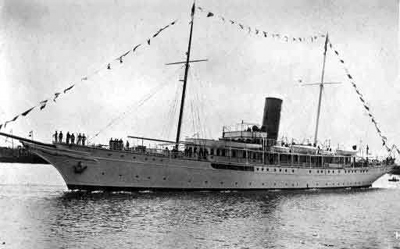
Lord Tredegar’s Yacht ‘Liberty’ during the South Lock Extension opening ceremony, 14th July 1914
This last phase of construction was important not only because it extended the area of the dock by another 28 acres, but rather because it was in this phase that the new South Lock, or Great Sea Lock, was constructed. When completed the Lock allowed shipping to enter the Docks directly from the Bristol Channel for the first time. At over 1,000 feet long and 100 feet wide it was claimed that the Lock was the largest in the World and ensured that Newport was easily able to accommodate the largest ships then afloat. The South Lock was officially opened on 14th July 1914 by Prince Arthur of Connaught, the Son of King George V. Lord Tredegar’s steam yacht ‘The Liberty’ became the first ship to pass through the Lock, when it transported Prince Albert to the Docks during the celebrations.
It was during the construction of the South Lock that one of the most celebrated events in the history of Newport occurred, the Newport Dock Disaster and the heroism of Tom ‘Toya’ Lewis. On 2nd July 1909 at 5:20 in the afternoon, just minutes before the workers were due to finish for the day, the timbers supporting the West Wall excavation trench collapsed. Under tremendous pressure, the timbers rose, were forced together and the sides of the trench fell in, instantaneously burying the 46 men working at the bottom of the trench. Over 500 men were soon at the scene attempting to reach the men trapped below.
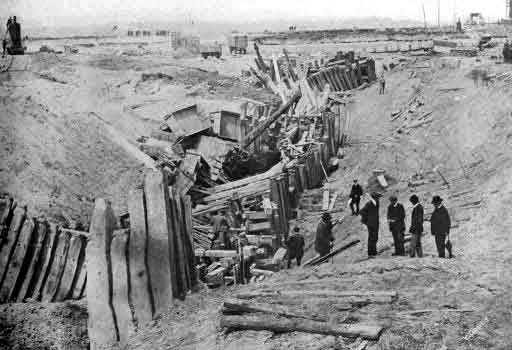
West Wingwall Trench after the collapse, 4th July 1909
Thomas Lewis was amongst the crowd of spectators when he answered a call for a volunteer to attempt to reach a man trapped below. Crawling through a small space Tom worked for two hours with a hammer and chisel to try to free the man before officials insisted he return to the surface. The trapped man was rescued the next day. The people of Newport expressed their gratitude to Tom by raising several hundred pounds through a public subscription, enough money for him to be sent to Scotland on an engineering scholarship. He was awarded the Albert Medal by the King in December 1909.
Following the completion of the South Dock, Newport was able to provide a co-ordinated Docks system capable of handling both coal and general cargo. Larger vessels used the South Dock with its direct access to the Bristol Channel while smaller vessels used the North Dock, Town Dock and the River Wharves which had to be navigated via the River Usk.
In 1922 control of the Docks passed from the Alexandra (Newport and South Wales) Docks and Railway Company to the Great Western Railway, and despite investment in dock facilities the GWR was faced with the sudden downturn in world trade caused by the depression.
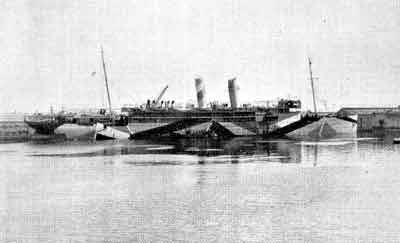
H.M Auxillary Cruiser ‘Macedonia’ in Alexandra Docks during World War One.
The decision was taken to concentrate resources on the Alexandra Docks and the Town Dock was closed in 1930. Emphasis was placed upon developing the general cargo trade, rather than the declining coal export trade, and during the Second World War the dock facilities at Newport played an important role in fuelling the war effort.
Following the Second World War the Alexandra Docks continued to adapt to changing circumstances. On 1st January 1948 control passed to the British Transport Commission following Nationalisation. In August 1964 all coal shipping at Newport ceased, as the decision was taken to concentrate all South Wales Coal shipping at Barry and Swansea, but this proved to be a temporary halt as coal shipments started again in 1981.
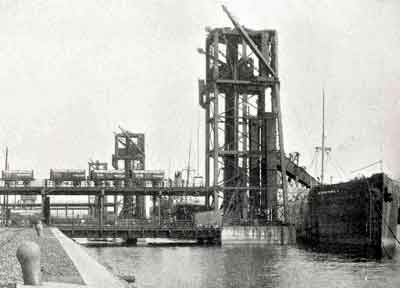
Vessels loading coal at the South Dock Hoists, circa 1919
During the late 1950’s and early 1960’s iron ore became an important cargo following the construction of the Llanwern Works, although these imports ceased in 1975 as all this trade was diverted to the recently completed Port Talbot Tidal Harbour.
In 1980 the Jamaica Terminal was built to handle the imports of Jamaican Bananas and during the 1980’s car terminals were set up within the Docks Estate to handle the import of Japanese cars. By the early 1990’s Newport had become established as one of the major timber handling facilities in the UK. Today the Docks is owned by the Associated British Ports and handles a wide variety of general cargo, including timber products, minerals, ores and steel products.
These web pages were written using material held in the Local Studies Collection at Newport Central Library, including:
Newspapers
- The Monmouthshire Merlin
- The South Wales Argus
Printed Works
-
- Alexandra (Newport and South Wales) Docks and Railway Company. (M160 627.3 ALE)
- Newport : The Ocean Gateway to the Midlands(M160 627.3 ALE)
- Home Office - Report to the Secretary of State on the Disaster at the Alexandra Dock, Newport (qM160 627.3 ALE)
- Hutton, John - The Newport Docks and Railway Company (M160 387.1 HUT)
- Spanswick, B J. - A Study of the Origins and Early Development of Newport Docks. (qM160 627.3 SPA)
- Smith, T. G. - A Customs History of the Port of Newport in Gwent Local History No. 46 (Spring 1979) (M000 900 GWE)
If you wish to learn more about the history of Alexandra Dock, or any other aspect of Newport’s history, visit the Central Reference Library where staff will be happy to assist you. They can also be contacted by telephone on 01633 656656 or email at reference.library@newport.gov.uk
Town Dock
The Town Dock, which opened in 1842 and continued in use until it was filled in 1930, was the first floating dock facility in Newport. The construction of the dock played an important part in the town’s growth in the mid Nineteenth Century. A rapid expansion of trade caused by the development of the canal system in South East Wales had led to the need to improve the port’s berthing facilities. Particularly for large American export vessels which risked damage when beached at the wharves for unloading. If the town was to continue to prosper and compete with the growing port of Cardiff a dock needed to be constructed.
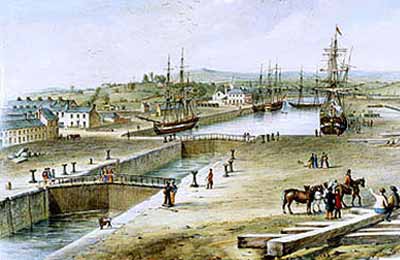
The Town Dock, a sketch by J F Mullock, circa 1842
At a public meeting held at the King’s Head Inn in March 1835 the plans of the floating dock were agreed. A committee, made up of some of the leading gentlemen of Newport, was appointed to examine the provisions of the Bill that was to be put before Parliament.
The Newport Dock Act was given Royal Assent in July 1835 allowing the Newport Dock Company to begin construction work. The estimated cost of the dock was to be £35,000 which was raised by selling 350 shares of £100. The first sod was cut by John Owen, Mayor of Newport, on 1st December 1835 to the sound of the bells of St Woolos, the firing of guns and the celebrations of the Navvies, who had been supplied with several barrels of Castle Brewery beer for the occasion.
However, the construction of the dock did not run smoothly. A number of contractors had to be used at various stages and as early as 1836 there were labour disputes. Consequently, even by the end of 1837 little work had been completed. In 1838 another £15,000 needed to be raised but progress continued to be slow. More funds needed to be raised in October 1840 and by then the estimated cost of the project had risen to £120,000. Work was halted in December 1840 following the failure of another contractor and was to halt again in 1841. After more funds were raised work resumed for a fifth time in April, but by then the total estimate had grown to £131,000. Financial problems and industrial unrest continued to plague the construction to the very end. In September 1842 a further £10,000 had to be borrowed and workers walked out to demand higher wages, an event which led to a body of well armed police being sent to quell the disturbance.
The official opening of the Dock on 10th October 1842 was marked by a programme of festivities that attracted tens of thousands of visitors to the town. In the morning a mile long procession proceeded along High Street through Commercial Street and Commercial Road towards the Dock. The procession contained elements of the major clubs and societies of Newport in this period such as the Freemasons, the Oddfellows, The Hibernian Society and the Teetotallers. Near the head of the procession the Mayor and Aldermen travelled in open carriages whilst at the rear marched a large number of the inhabitants of the town, amongst whom many of the gentlemen wore white rosettes.
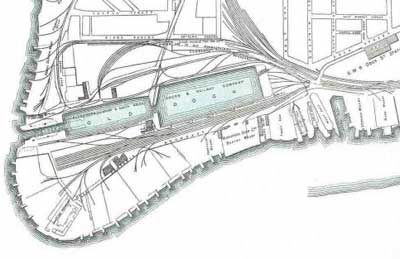
Map of the Town Dock and Surrounding area, circa 1905
At 10-o-clock the lock gates were opened, as the Monmouthshire Merlin reported, to the sound of “the shouts and cheers of the spectators, the thunder of cannons, firing of musketry and pealing of bells.” The first vessel to enter the dock was the Henry.
Following the official opening the programme of events continued throughout the day. Highlights included a dinner for 300 gentlemen of the area at the National School, boat races on the dock reservoir and a firework display at Rodney Wharf. In the evening a ball was held for the gentry at the King’s Head Hotel. The Clubs and Societies also held their own balls and dinners at Inns throughout Newport, a Tradesman’s Ball at the Steam Packet Inn was reported to have “kept up with much spirit until morning”.
The Monmouthshire Merlin newspaper does not report on how the town’s population felt the next day.
However, shortly after its opening it was apparent the existing dock was not sufficient to deal with the increasing trade. In July 1854 a second act was passed giving the Newport Dock Company permission to extend the dock to the North. Work commenced in June 1856 and was completed in less than two years. The official opening on 2nd March 1858 was declared a public holiday and was greeted with similar celebrations to when the dock was opened in 1842.
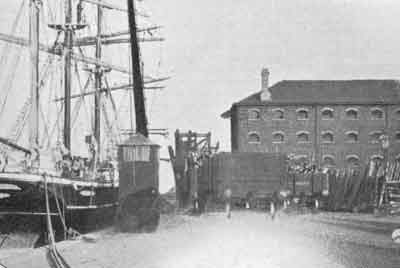
Timber Ship and Warehouse at the Town Dock, circa 1905
The dock expansion was not initially the success that the Newport Dock company hoped for and the company faced severe criticism, especially after they increased their charges. It was now obvious that the Town Dock alone was no longer sufficient to meet the volume of trade passing through Newport. In 1865 an act was passed to allow the construction of a second dock and in 1868 work began on the Alexandra Dock, which opened in 1875.
Unsurprisingly, the opening of the rival dock had a detrimental effect on the trade of the Town Dock, although it was the accident involving the Constancia and the Primus which ultimately led to the demise of the Newport Dock Company.
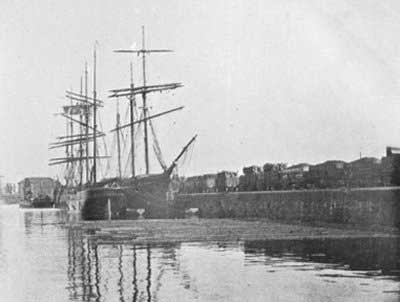
Unloading timber for pit props at the Town Dock, circa 1905
On 10th January 1882 the two vessels attempted to pass through the lock at the same time but the Primus became stuck on the sill of the outer gates and the ships collided. The Monmouthshire Merlin describes how the situation became critical as the tide began to recede because “the bottom of the lock being concave in form, as the water ebbed the steamers heeled over one on the other, the Primus carrying away her masts, breaking in two amidships and, of course, subsiding to the bottom, whither she was followed by her companion in misfortune.” The lock was completely blocked and the vessels already in the dock trapped for nearly two weeks. The accident incurred substantial expense for the Newport Dock Company and further eroded customer confidence in the company.
A year later the Newport Dock Company was sold to the Alexandra Dock Company for £150,000. From this moment the Town Dock was used for dealing with the smaller vessels whilst larger cargoes were concentrated at the Alexandra Dock. By 1900 the Town Dock was used primarily for the general import trade, particularly in timber. However, its relatively small size and position further up the river estuary than the Alexandra Dock made the Town Dock particularly vulnerable. Unable to survive the downturn in trade in the 1920’s the Town Dock was finally closed in October 1930.
These web pages were written using material held in the Local Studies Collection at Newport Central Library, including:
Newspapers
- The Monmouthshire Merlin
- The South Wales Argus
Printed Works
- Leonard, T. Newport Town Dock 1835 - 1842. (qM160 627.3 LEO)
- Spanswick, B J. A Study of the Origins and Early Development of Newport Docks. (qM160 627.3 SPA)
- Alexandra (Newport and South Wales) Docks & Railway Company. (M160 627.3 ALE)
- Smith, T. G. A Customs History of the Port of Newport in Gwent Local History No. 46 (Spring 1979) (M000 900 GWE)
If you wish to learn more about the history of Town Dock, or any other aspect of Newport’s history, visit the Central Reference Library where staff will be happy to assist you.
They can also be contacted by telephone on 01633 656656 or email at reference.library@newport.gov.uk
Port chiefs unveil plaques remembering worst peacetime disaster in Newport.
PORT authority bosses unveiled new plaques remembering workers who died building a lock in the worst peacetime disaster in Newport.
They gathered at St Woolos Cemetery to honour the 39 people who lost their lives after a trench collapsed during construction of the new South Lock at Newport Docks in 1909.
You can read more about this in this event in the article published by the South Wales Argus here.